

Coppe inaugurates chemical recycling plant
Planeta COPPE / Chemical Engineering / Energy / Smart Cities / News
Date: 19/11/2025
Research that transforms: science as a protagonist of future changes
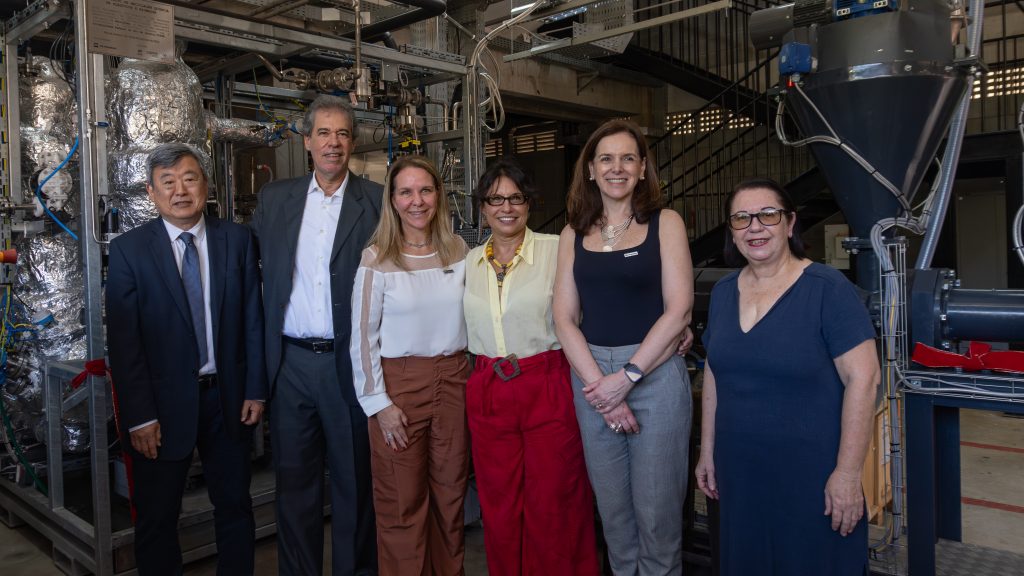
Coppe/UFRJ and Petrobras inaugurated the Chemical Recycling Pilot Plant this Tuesday (11/18) — a scientific and technological milestone towards the circular carbon economy. The project, conceived and operated by the Polymerization Engineering Laboratory (EngePol), in partnership with the Macromolecules Institute (IMA/UFRJ) and Petrobras, has the capacity to process up to one ton of plastic per day, strategically expanding research and development of technologies for the sustainable management of plastic waste.
Recently back from COP 30 in Belém, Coppe’s director, Professor Suzana Kahn, highlighted that, although the debate on the energy transition is more present on the global stage, there is little discussion about the numerous petroleum-derived products—among them, plastic—for which there are still no adequate substitutes. “This leads us to recycling, the circular economy, reverse logistics—what we call the dematerialization of economy,” she stated.
According to the professor, Pilot Plant represents not only an advance in research and development, but also an instrument for raising awareness about the economic and environmental value of reusing raw materials. “If we don’t reduce the pressure on natural resources, the world will collapse. The campus functions as a sounding board for good practices and good technologies, and this Pilot Plant deserves recognition in this mission.”
EngePol’s coordinator, professor José Carlos Pinto,from the Chemical Engineering Program, recalled that the demand for solutions is urgent: the world production of plastics exceeds 400 million tons, and only 9% is recycled. “Only 30% can be recycled mechanically. Chemical recycling complements this process, reinserting molecules into the production chain.”
He also emphasized the strategic nature of the project: “A cup or a plastic bag cannot have landfills as their final destination. Plastics can be purer sources of carbon and hydrogen than certain fractions of petroleum. We manipulate temperature, pressure, hydrogen, and catalysts to fully utilize gas, liquids, and solids. It is about reinserting carbon and hydrogen in an absolutely circular way.”
According to Renata Baruzzi, Petrobras’ executive director of Engineering, Technology and Innovation, the Plant symbolizes integration between academia, industry and society. “The project is aligned with Petrobras’ commitment to generating social value, promoting innovation and protecting marine and terrestrial ecosystems.”
She further emphasized the practical impact of the solution: “Materials that would otherwise be discarded become potential raw materials for refining and for the petrochemical industry, especially soft plastics — found in food packaging and bags — which are unlikely to enter conventional recycling processes.”
Science as a lever for national development
Professor Francisco Esteves, coordinator of Sustainability and Regenerative Education at UFRJ, warned about the ecological and social damage related to the improper disposal of plastic, noting that even microscopic marine organisms — such as polychaetes — already show contamination by microplastics. “This microplastic travels through the food chain and reaches the bloodstream. Today we find microplastics even in the brain and heart.” He also highlighted the historical and strategic role of Coppe for the country: “Offshore oil exploration in Bacia de Campos was born here, at Coppe. For decades, this institution has been driving Brazil’s development.”
The event also featured presentations by the Dean of the Technology Center, Professor Walter Suemitsu; Professor Emerson Oliveira (IMA/UFRJ); André Bello, R&D Manager for Sustainable Products at Petrobras; Lílian Canabarro, R&D Manager for Biorefining at Petrobras; researcher Cristine Carvalho (Orla Sem Lixo Project); and Cristiane Tolotti Rossi, Project and Process Manager for Circular Economy at Braskem.
