Knime at Coppe: Professors show low-code applications in teaching, research and industry
Planeta COPPE / AI and Digital Transformation / Ocean Engineering / Systems Engineering and Computer Science / News
Date: 22/10/2025
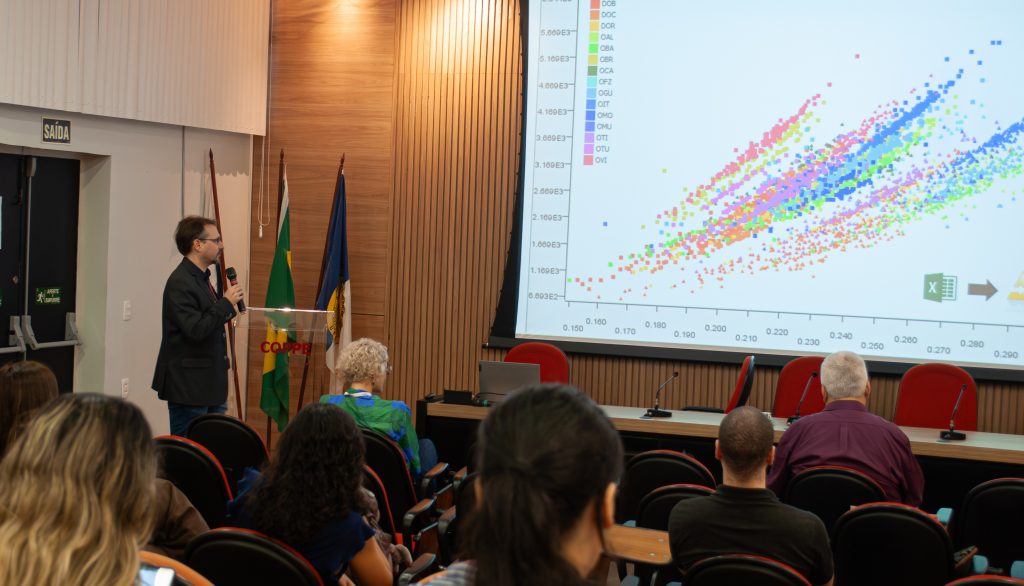
Visual data science tools are transforming the way researchers and students explore large volumes of information. This was the focus of the event “Knime Applications in Research, Teaching, and Industrial Projects,” which brought together Coppe professors Geraldo Xexéo and Jean David Caprace, from the Systems Engineering and Computer Science Program (PESC) and the Ocean Engineering Program (PENo), respectively, to share experiences and concrete results using Knime, a free and open-source platform for data analysis and text mining.
The event also featured Aline Bessa, a data scientist at Knime, a company with around 250 employees founded at the University of Konstanz, Germany. She explained that Knime is both the name of the startup and the platform it develops, and detailed how the tool supports the entire data science cycle, involving two main stages: creation and production. Aline emphasized that the platform is open source and free, and that its philosophy seeks to democratize data science, connecting academia, startups and industry in the exploration of complex data.
Inclusive Teaching and Concept Visualization
Xexéo highlighted Knime’s role in teaching text mining and machine learning, especially to students without a computer science background. With the tool, analysis workflows—from text cleaning and vectorization to pattern and sentiment detection—become visual and intuitive.
“Teaching concepts is more important than teaching programming,” he stated. According to him, Knime allows students in various fields, from sociology to medicine, to understand the data analysis process without needing to master coding languages. Projects conducted in the classroom include detecting toxicity in online games and early identification of predatory behavior in digital conversations.
From classroom to industry
Jean David presented industrial applications of Knime in strategic sectors such as energy and maritime transportation. In partnership with Petrobras, corrosion models were developed on platforms and predictive energy efficiency systems for ships, resulting in publications in international journals such as Marine Structures e Ocean Engineering.
Other examples include storm surge prediction models and maritime decarbonization simulations used by the International Maritime Organization (IMO). “In a meeting with Petrobras, it took me five minutes to build a solution in KNIME that saved weeks of work,” he reported.
Integration with LLMs and new frontiers
The presentations also addressed KNIME’s integration with language models (LLMs) and intelligent agents. The use of controlled flows allows for the reduction of typical hallucinations in large models and the creation of cooperative systems for tasks such as intention classification, data extraction and automated response generation.
“LLMs hallucinate and it’s normal for them to do so—the important thing is to control this process with well-structured flows,” explained Xexéo, highlighting the pedagogical and scientific value of an approach that combines transparency and traceability.
Research and productivity with real impact
The results presented reinforce that low-code tools like Knime go far beyond prototyping. Projects led by faculty and their research groups demonstrate reductions of up to 35% in development time, processing capacity for databases with over 120 million lines and applications in projects funded by CNPq, Petrobras, RNP and AWS.
Democratization of data science

For both professors and Aline Bessa, the platform represents a collaborative and inclusive work philosophy that connects academia with industry and expands access to data science. Its versatility allows the same environment to be used by both beginning students and researchers developing complex predictive models.
More than just showcasing a tool, the event highlighted Coppe’s vision of transforming science into innovation and social benefit, bringing the university closer to real-world challenges and demands.