MagLev-Cobra may feature national technology in the magnets of its tracks
Planeta COPPE / Electrical Engineering / News
Date: 09/07/2026

Coppe/UFRJ reaffirms its leadership in developing technological solutions for the challenges of sustainable mobility and industrial innovation with another advancement of MagLev-Cobra, a magnetic levitation train developed in partnership with the Polytechnic School (Poli). By October of this year, the automated version of MagLev, produced by the company Aerom, and with support from Faperj, should begin testing, transporting passengers on the experimental line at the UFRJ Technology Center.
According to Professor Richard Stephan, coordinator of the project and professor of the Electrical Engineering Program at Coppe and Poli, a funding proposal was submitted, in parallel, to Finep to carry out a Technical, Economic and Environmental Feasibility Study (EVTEA). The study aims to identify the location for the expansion of the vehicle’s route, according to the project schedule. The expansion could allow MagLev to reach UFRJ’s Science Park, which is one of the possibilities, traversing curves and inclines, which will expand the validation of the superconductivity technology employed in the system.
Richard Stephan explains that MagLev-Cobra’s support is obtained through superconductors installed on the underside of the vehicle and rails formed by rare-earth magnets. “It is precisely in this component that a new technological advancement could further strengthen national autonomy.

During the seventh edition of the Brazilian Rare Earth Congress (VII CBTR), held on July 2nd at UFRJ’s Technology Center, Richard presented MagLev-Cobra to students, researchers, entrepreneurs and investors from across the country and advocated for strengthening the national production of permanent magnets. After the event, dozens of participants visited the vehicle.
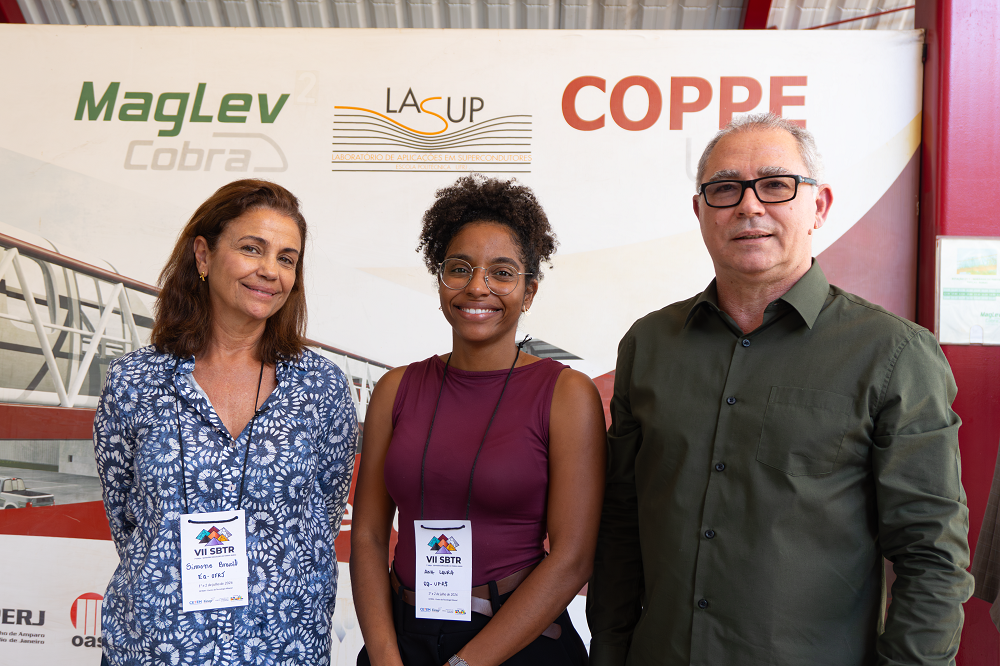
The professor highlighted the need to import a new shipment of magnets from China, now with more corrosion-resistant coatings, to replace the current ones, which had begun to show rust spots. At the same time, he pointed to a promising prospect: the development of a coating using Brazilian technology, the result of the doctoral research by Ana Laura Campista, from the Chemical and Biochemical Process Engineering Program (EPQB) at the School of Chemistry of UFRJ, under the guidance of professors Ladimir José de Carvalho and Simone Louise Brasil.
According to Ana Laura, metallic coatings used on magnets suffer wear and tear over time, especially when exposed to humidity and rain. The new imported magnets already use materials that offer greater corrosion resistance. However, the technology she is developing in her research has the potential to further enhance this protection, extending the lifespan of the magnets and reducing maintenance costs.
The interest generated by the project also attracted the attention of researchers from other institutions. Isadora Marcela de Campos, a doctoral candidate in Industrial Engineering at the Federal Technological University of Paraná (UTFPR), who participated in the congress, stated that she has been following research on rare-earth elements since her master’s degree and considers the strengthening of this production chain in Brazil to be strategic.

“Brazil imports rare-earth magnets from China, so if we can produce, develop and use this material here, it will be extraordinary, since we have the technological capacity, skilled workforce and experts involved who want to implement this. Now, it’s a task force and we need investment and political will to continue the development and compete in the international market with products made here in Brazil,” argues Isadora.
In addition to representing a milestone for low-carbon urban mobility, MagLev-Cobra consolidates Coppe’s ability to transform scientific knowledge into innovation with the potential for economic and social impact. Research focused on the nationalization of strategic components demonstrates how the university contributes to reducing the country’s technological dependence and strengthening a high added value production chain.