Nuclear energy, decarbonization and energy security: a strategic debate promoted by Coppe
Planeta COPPE / Energy / Institutional News / Low Carbon / Nuclear Engineering / News
Date: 28/08/2025
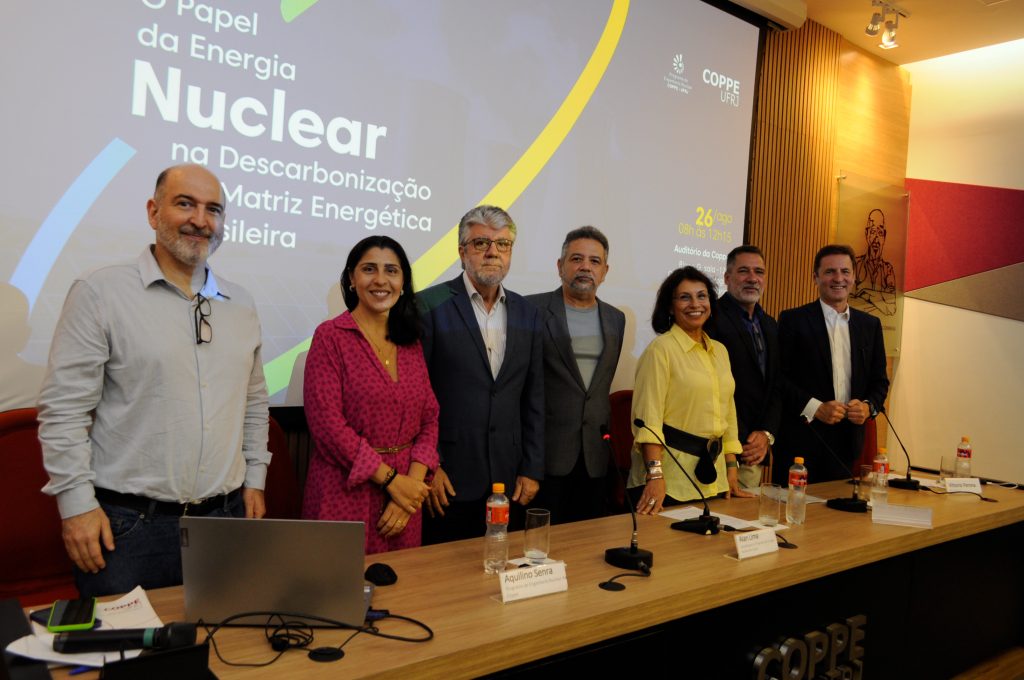
Coppe/UFRJ promoted, this Tuesday (26th), a meeting to discuss the role of nuclear energy in Brazil’s energy transition, addressing energy security, decarbonization goals and the country’s integration into high value-added energy chains. The debate brought together representatives from academia, industry and government, reaffirming the university’s role as a space for addressing sensitive issues with a technical foundation and strategic vision.
Three Strategic Axes for the Energy Future
The energy transition is urgently needed to reduce greenhouse gas emissions, but it must be balanced with the challenges of energy security and equity. In this context, experts converged on three central points.
1. Nuclear energy as a stable and reliable source
Professor Aquilino Senra (PEN/Coppe) emphasized that the energy transition will not be viable without the participation of nuclear energy, as it is a dispatchable and non-intermittent source. He highlighted the advancement of small modular reactors (SMRs), capable of generating up to 300 MW, with automated operation and easy transportation. These technologies open up opportunities for strategic applications, such as maritime transport – responsible for approximately 4% of global emissions –, mining and data centers.
2. Integration with Other Sectors and Socioeconomic Benefits
For Giovani Machado, founding partner of Episteme and former director of studies at EPE, nuclear energy goes beyond generating electricity: “It ensures reliability, promotes decarbonization and enables coupling with sectors such as hydrogen, the thermal industry, navigation, defense and data centers, in addition to generating technological spillovers and socioeconomic benefits.”.
3. Safety, public perception and state policy
Renato Dutra, director of the Department of Petroleum-Based Fuels at the Ministry of Mines and Energy, reinforced that energy policy is a state policy, guided by the trilemma: sustainability, security, and equity. “The transition needs to be consistent, without compromising energy security and without aggravating energy poverty,” he warned.
Along the same lines, Vittorio Perona, a partner at BTG Pactual, highlighted the need to inform society about the safety of the nuclear program. “Accident rates in the construction and operation of nuclear power plants are much lower than with other technologies. It is up to academia and the media to disseminate this data.”.
The Energy Research Company (EPE) was also represented by Patrícia Nunes, and the Nuclear Industries of Brazil (INB) by Márcio Adriano Coelho da Silva, reinforcing the integrated vision between research, planning and the production sector.
Debate to decide

The event, titled “The Role of Nuclear Energy in the Decarbonization of the Brazilian Energy Matrix,” is part of a series of debates organized by Coppe/UFRJ leading up to COP 30, addressing topics such as climate change, energy security, and technological innovation.
“Every choice made, among the many possible paths to decarbonization, entails a series of consequences, pros and cons. What we aim to do, and this is the role of academia, is to understand the consequences of our choices as a country,” concluded Suzana Kahn, Coppe’s director, who moderated the meeting alongside Professor Alan Lima, coordinator of the Nuclear Engineering Program (PEN).
The full event is available on Coppe’s YouTube channel.
- Decarbonization