

Specialist discusses just and equitable transition in international navigation
Planeta COPPE / Blue Economy / Low Carbon / Ocean Engineering / News
Date: 27/08/2025
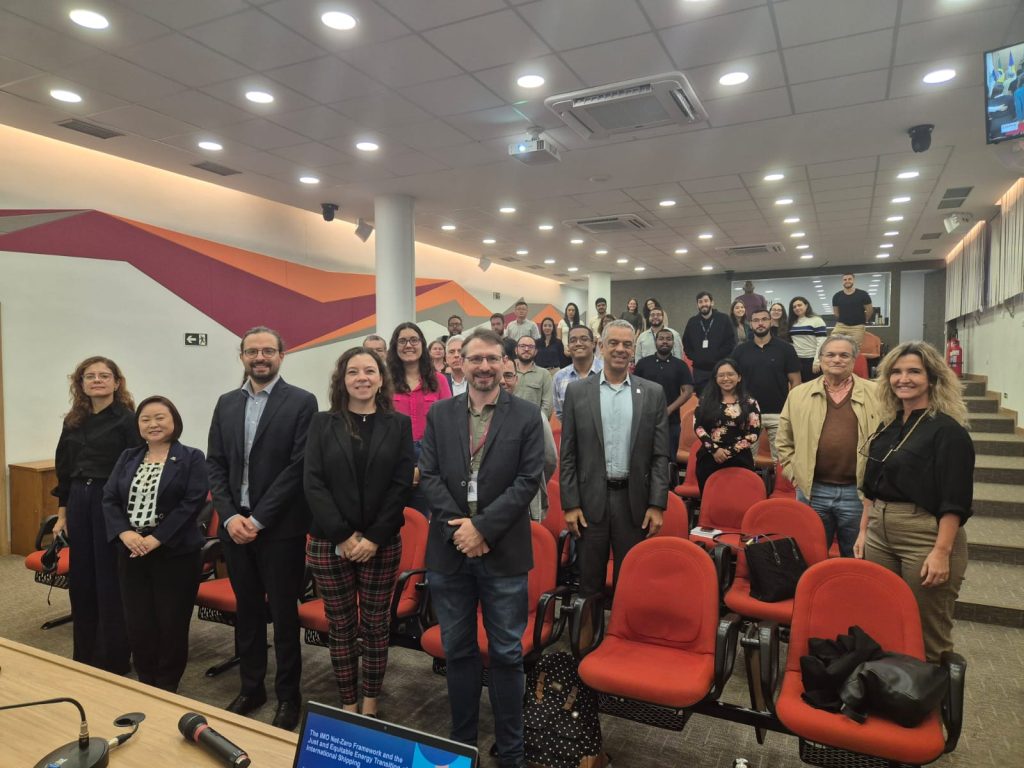
On August 6th, Coppe/UFRJ welcomed Professor Goran Dominioni of Dublin City University. Dominioni is currently the principal investigator (PI) of a World Bank-funded project on the implementation of climate change mitigation policies in international shipping. The professor addressed the need for a just and equitable transition in the sector during a lecture given to students of the Ocean Engineering Program, which attracted researchers from other institutions due to the topical relevance of the discussion.
Since 2022, the professor has organized and delivered training on carbon pricing in maritime transport for members of delegations alongside the International Maritime Organization (IMO), covering more than 60 developing countries.
Maritime shipping is responsible for 2% to 3% of global greenhouse gas emissions and moves approximately 80% of international trade by volume. The global goal is to achieve net-zero emissions by, or close to, 2050, with intermediate reductions of 20% to 30% by 2030 and 70% to 80% by 2040.
These rules apply to ships over 5,000 tons, with exceptions for non-motorized vessels, platforms and ships operating exclusively in waters under national jurisdiction.
According to Dominioni, IMO’s Net-Zero Framework is not a binding document (which binds countries), but rather a reference. “It’s challenging for industries and for the IMO. It represents an important step forward, with technical and economic elements, but many uncertainties remain.”.
“Which fuels will be encouraged, which will be available and where? Key aspects of the framework related to the ‘just and equitable transition’ still need to be defined. What will be the criteria for use and governance of the IMO Net-Zero Fund (a global financial mechanism created to support the decarbonization of the shipping sector and consisting of mandatory contributions paid by ships that emit greenhouse gases above established limits), which could distribute up to 15 billion dollars? The sector will likely have to adapt to a patchwork of climate policies, which will require creative responses to face new challenges.”
“People don’t want to call this a carbon tax, but it really feels like one.
At a time of great geopolitical strife, it’s encouraging to see the international community adjusting this policy,” Dominioni concluded.Professor Goran Dominioni’s lecture is available on YouTube and he provides more details on the topic in this article.
- Decarbonization
